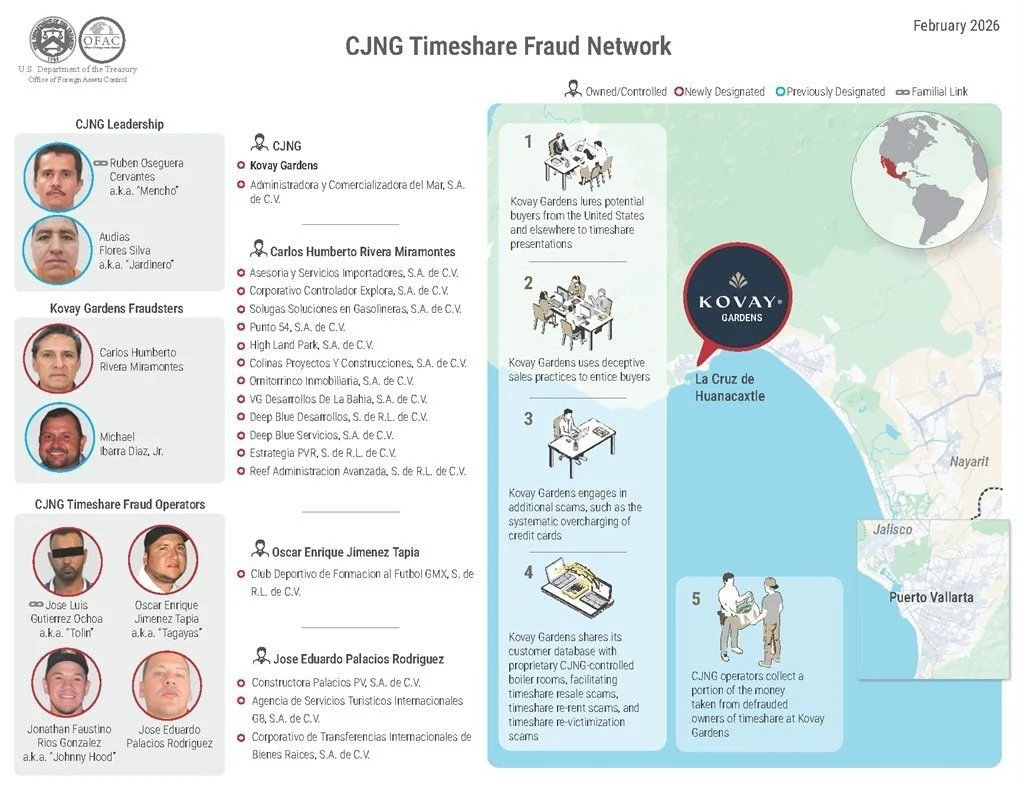
CJNG’s Expansion Into Financial Crime: The Nayarit Timeshare Fraud Network
Recent coordinated actions by the U.S. Treasury (OFAC) and Mexico’s Unidad de Inteligencia Financiera (UIF) exposed a large-scale timeshare fraud structure operating in Puerto Vallarta and Bahía de Banderas, a scheme tied directly to the Cártel Jalisco Nueva Generación (CJNG).
This case is important because it highlights a continued evolution: cartel revenue is no longer limited to narcotics trafficking. It now includes organized financial fraud targeting foreign victims, particularly retirees.
⸻
Leadership and Command Structure
• Rubén Oseguera Cervantes (“El Mencho”) – CJNG supreme leader (subject of U.S. reward offer)
• Audias Flores Silva (“El Jardinero”) – regional CJNG commander overseeing the fraud network
⸻
Financial & Corporate Network (Kovay Gardens Structure)
The investigation identified a business-front ecosystem designed to attract U.S. tourists into fraudulent timeshare sales and resale scams centered around the Kovay Gardens complex in La Cruz de Huanacaxtle, Nayarit.
Key facilitators identified:
• Carlos Humberto Rivera Miramontes
• Michael Ibarra Díaz Jr.
Associated companies included multiple real estate, tourism, consulting, and development entities used for payment processing and laundering operations.
⸻
Operational Collectors and Coordinators
Lieutenants collecting payments from call centers (“boiler rooms”):
• Oscar Enrique Jiménez Tapia (“Tagayas”)
• José Luis Gutiérrez Ochoa (“Tolín”) — reported familial connection to Mencho
Sub operators running scam rooms and victim contact operations:
• Jonathan Faustino Ríos González (“Johnny Hood”)
• José Eduardo Palacios Rodríguez
⸻
Modus Operandi
Authorities identified a structured fraud pipeline:
1. Victims, mostly U.S. timeshare owners were contacted with resale or investment offers
2. High pressure presentations and fabricated legal/closing fees were used to obtain payments
3. Credit cards were repeatedly charged or victims were re-targeted
4. Funds were routed through Mexican companies tied to the network
5. A portion of proceeds was delivered to CJNG financial channels
Thousands of victims reportedly lost hundreds of millions of dollars.
⸻
Government Action
• OFAC sanctioned individuals and companies linked to the scheme
• UIF froze accounts and expanded Mexico’s blocked persons list
• Authorities confirmed the cartel is diversifying into real estate fraud and financial crimes alongside traditional activities such as drug trafficking and fuel theft
Cartels today don’t just control territory, they embed inside legitimate-looking business systems.
This is exactly why serious cross-border due diligence is no longer optional, it’s a core risk-management function.